
Leaving tech for the trades: how Blake Alford found his creative spark in window cleaning
There is a certain Shortsightedness to the present moment – a persistent belief that we are living through unprecedented times. We look at the shifting economy, the surplus of college degrees, and the sudden scarcity of skilled trades, and we convince ourselves that we are the first to face this reckoning. We tell ourselves that the “death of the white-collar dream” is a crisis unique to our moment.
The modern antidote to this white-collar fatigue is broadcast daily on social media. You’ve likely seen the threads: a growing wave of corporate professionals preaching a new gospel. Their advice is to quit the soul-crushing office job, buy or start a “boring” service business, like HVAC, plumbing, or window cleaning, and get to work. While some are looking for passive income, many are trading their laptops for work boots, ready to roll up their sleeves and fill the gap. To a generation raised on screens, this pivot to the “real world” feels like a revolutionary discovery – a brilliant, original life raft constructed specifically for our drowning workforce.
But we are not the pioneers we think we are. This sense of unique discovery is an illusion. The truth is, we are simply stumbling back onto a path that was mapped out generations ago. It turns out the old adage is true: history rhymes. And sometimes, it doesn’t just rhyme – it screams the exact same warning across the decades.
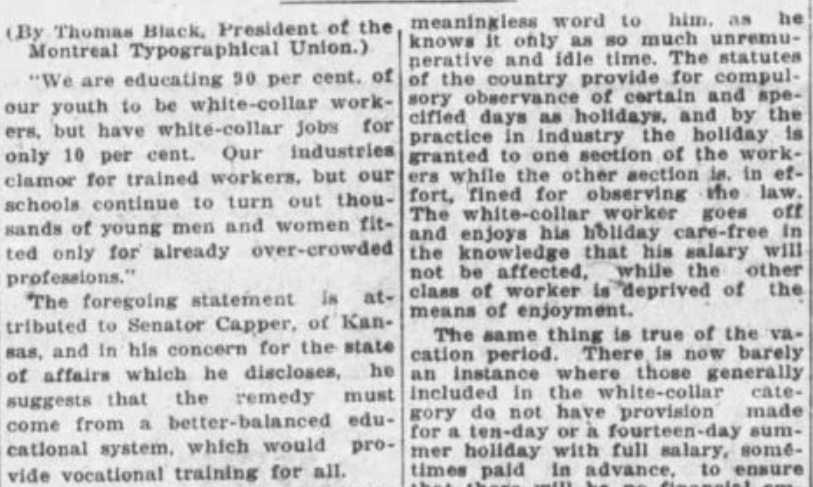
In 1924, exactly a century ago, Senator Arthur Capper of Kansas looked at the American workforce and issued a warning that could have been tweeted this morning:
“We are educating 90 percent of our youth to be white-collar workers, but have white-collar jobs for only 10 percent. Our industries clamor for trained workers, but our schools continue to turn out thousands of young men and women fitted only for already over-crowded professions.”
Sign up for the Manytown newsletter
It appears we have been living through this “uniquely modern crisis” for exactly a hundred years. Which brings us to Jamison “Blake” Alford, the latest defector from the corporate world and owner of Lucky’s Wash Co., a Charleston-based window cleaning company.
When I reached out to Blake, I assumed he fit the Twitter/X trend perfectly – another white-collar worker fleeing to the trades driven by online influencers and the promise of better margins. I was wrong. Blake wasn’t drawn to window cleaning by economic anxiety or social media gurus. After 15 years in the tech world, it was his creative side that felt starved. “I grew up in Charleston and was a student at the Charleston School of Arts,” Blake tells me. “I did theater. I’ve always had a piece of that in me and haven’t got to use it.”
You’re probably wondering what creativity has to do with window cleaning. The answer is everything.
There is a reason why product businesses are easier to build into brands than service businesses. If you are selling a sneaker or a phone, you can show off the stitching, the screen, or the sleek design. But service businesses, whether it’s a law firm or a window cleaning company, tend to drift into becoming commodities. The product is invisible until you use it, so it is nearly impossible for a customer to distinguish quality from mediocrity before they buy. Blake understood this from day one, which is why he started with the brand rather than the service.
It all starts with a name. For Blake, Lucky’s serves a dual purpose. It captures the happy-go-lucky charm of the mid-century aesthetic he aimed to recreate, but it is also a quiet nod to the capital that made the company possible. Before learning to use a squeegee, Blake spent five years as a professional poker player, traveling the country and eventually taking down a World Series of Poker Circuit championship in Iowa. He used his poker earnings to fund his venture.
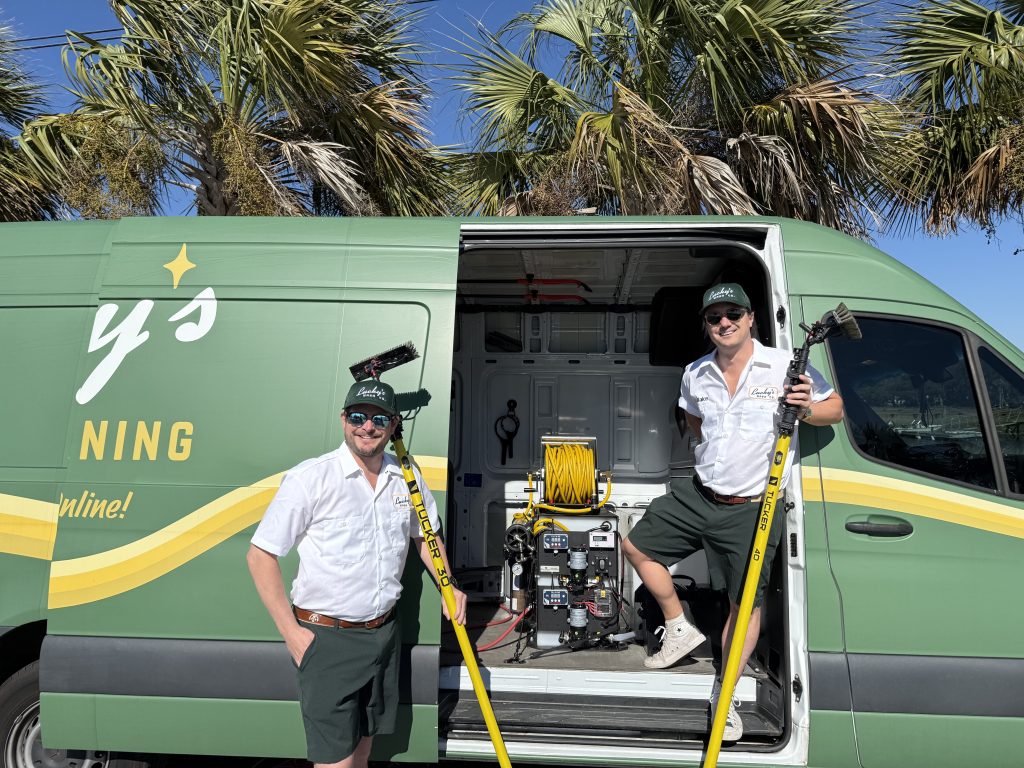
With the name established, Blake turned his attention to visual identity. He wanted to evoke an inviting and warm feeling, so he went nostalgic. “We leaned into the 1950s style,” he says. Instead of the standard T-shirt, he opted for button-down Dickies style workwear. But the boldest design choice was the company vehicle. While most service vans display as much as possible – phone numbers, email addresses, and “5-Star” badges – Blake went the opposite direction. His matte-wrapped van includes the company name, a QR code, and the phrase “get an instant quote online.” “I tried to take out as much fat as I could,” Blake explains. “You can get rid of a lot if you’re memorable.”
Brand awareness was the next piece of the puzzle. In an industry largely driven by word-of-mouth and door-to-door solicitation, Blake is keeping sales on the back burner. “Sales is not part of our marketing campaign,” he shares. “People are tired of the constant bombardment of call to actions.” Instead, Lucky’s Instagram page is filled with entertaining videos (all done in-house by Blake and a rotating camera person) promoting other local businesses – the restaurants and shops that use the company’s services. The strategy seems to be working. Nearly 80% of Lucky’s new customers come from Instagram.
Beyond the branding and the videos lies a real business opportunity. When Blake surveyed the local window cleaning landscape, he realized there was no middle ground. On one end you had the corporate franchises, and on the other, the college hustlers going door-to-door. There was no option that felt both professional and personal – a critical gap in a city with historic homes that require a delicate touch that high-volume franchises often lack. Lucky’s is one of the only companies trusted by the Preservation Society to work on historic homes downtown. “I’ve always believed that opportunity is the greatest where service is the worst,” Blake says. “We’re local, we grew up in Charleston, and we’re here to maintain the beauty and charm of the city.”